
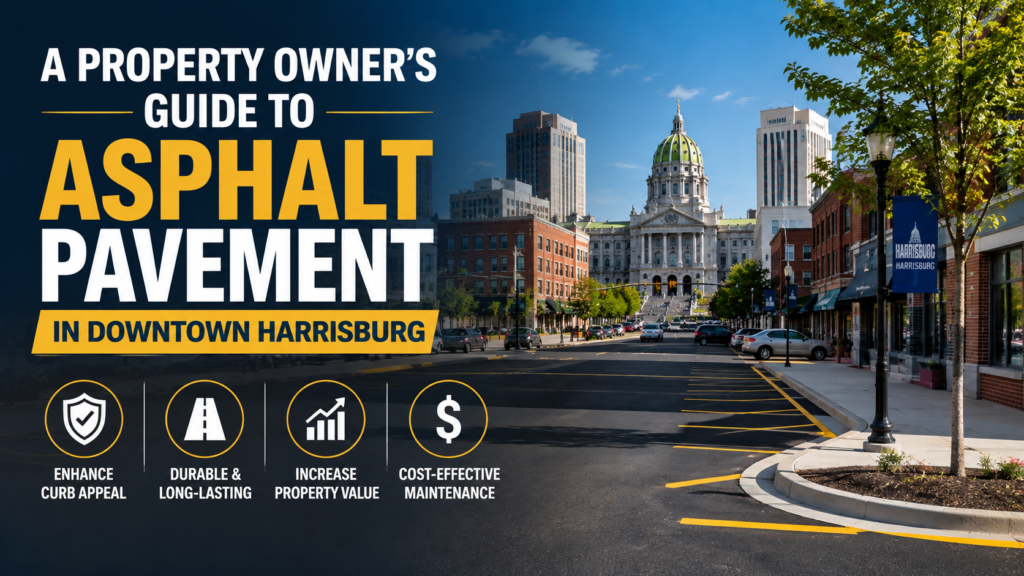
Downtown Harrisburg carries a different kind of pavement demand than the surrounding residential neighborhoods. As the seat of Pennsylvania’s state government and the commercial core of the capital region, downtown sees a steady mix of pedestrian traffic, commuter vehicles, delivery trucks, and municipal activity every day. Parking garages, government building lots, and commercial storefronts all depend on pavement that can hold up to consistent, heavy use while still looking presentable in a district that many visitors and state employees pass through daily.
For business owners, property managers, and anyone responsible for a commercial lot in this part of the city, understanding how asphalt behaves under high-traffic, high-visibility conditions is useful background before undertaking any paving project. This article covers the practical, general information people most often look for when researching pavement in a busy downtown setting.
Why Traffic Volume Changes How Pavement Wears
Pavement in a downtown business district experiences a different wear pattern than a quiet residential street. Repeated heavy loads, such as delivery trucks and buses, concentrate stress on the same lanes and turning points day after day. Over time, this creates rutting, which is a shallow depression that forms along frequently traveled paths, particularly at entrances, exits, and areas where vehicles brake or turn sharply.
Because downtown lots and streets see this kind of concentrated, repetitive stress, the asphalt mix and the thickness of the base layer used in commercial and municipal paving generally need to be more robust than what would be used for a single-family residential driveway. This is a core reason commercial paving specifications differ from residential ones, even when the visible surface looks similar.
Pedestrian Safety and Surface Condition
In a walkable downtown core, pavement condition is not just about vehicles. Sidewalks, crosswalk aprons, and parking lot surfaces all get significant foot traffic from state workers, shoppers, and residents. Cracks, potholes, and uneven surfaces are more than a cosmetic issue in this context; they represent a real tripping hazard in areas where people are walking briskly between buildings, often while distracted by traffic or carrying items.
This is one of the most common reasons commercial property owners downtown prioritize addressing surface damage quickly rather than letting it accumulate, since a property’s pavement condition also reflects on the businesses and offices it serves.
How Weather and Salt Exposure Affect Downtown Pavement
Harrisburg’s winters bring snow and ice, and downtown surfaces, from municipal streets to private parking lots, are treated regularly with de-icing salt to keep them safe for pedestrians and drivers. While necessary for public safety, repeated salt exposure can accelerate the wear of asphalt surfaces over time, particularly when combined with the freeze-thaw cycles typical of central Pennsylvania winters. Salt lowers the freezing point of water that has seeped into small cracks, which can extend the number of freeze-thaw cycles a crack experiences in a single season, gradually widening it.
Because of this, pavement in downtown commercial areas often benefits from a slightly more frequent inspection schedule than pavement in less exposed settings, especially heading into and coming out of winter.
Common Questions About Commercial and Municipal Paving
How often should a downtown parking lot be resealed? General guidance suggests every two to three years, though lots with heavy salt exposure or constant heavy vehicle traffic may need more frequent attention.
What causes rutting in high-traffic lanes? Rutting develops when repeated heavy loads compress the asphalt and the base beneath it along the same path, most often near entrances, loading zones, and turning areas.
Is asphalt or concrete better for a downtown business lot? Both materials are used successfully downtown. Asphalt is generally faster to install and more flexible under freeze-thaw stress, while concrete tends to handle extremely heavy, stationary loads well but is more prone to cracking from ground movement.
How does ADA compliance factor into pavement work? Accessible routes, curb ramps, and parking space markings need to meet specific slope and surface requirements, which is an important consideration for any downtown commercial or municipal paving project.
The Value of Regular Inspection in a Business District
Because downtown properties see so much daily activity, small pavement issues tend to become visible and get reported quickly, whether by tenants, customers, or municipal code enforcement. Establishing a routine inspection schedule, ideally each spring and fall, helps property managers catch cracking, drainage problems, and surface wear while repairs are still relatively minor.
A simple visual walk-through of a lot or sidewalk apron, checking for pooling water, cracking patterns, and uneven sections, can identify most developing issues well before they require significant work.
Drainage Considerations in a Dense Business Core
Downtown properties are often built close together with limited green space to absorb runoff, which places more importance on proper pavement grading and functioning storm drains. When a parking lot or loading area does not drain correctly, water can pool near building entrances or loading docks, creating both a safety hazard and a long-term source of pavement deterioration.
Because so much of downtown’s surface area is impervious pavement, coordinated drainage planning, ensuring that a property’s slope directs water toward the correct municipal or private drainage point, is one of the more technical but important aspects of any paving project in this part of the city.
Planning Pavement Work Around a Busy Schedule
One challenge unique to downtown paving projects is scheduling around business operations, delivery windows, and the general flow of pedestrian and vehicle traffic in a busy district. Projects are often planned in phases or scheduled for lower-traffic hours to minimize disruption to nearby businesses and commuters.
An experienced asphalt contractor downtown property owners and managers turn to typically factors these scheduling realities into a project plan from the start, recognizing that a commercial lot in the capital’s core cannot simply be closed off without careful coordination.
The Difference Between Asphalt Composition for Streets and Lots
Not all asphalt is engineered the same way. The mix design, meaning the specific combination of aggregate, sand, and asphalt binder, is adjusted depending on the expected load and traffic pattern of a given surface. Municipal streets downtown, which carry buses and heavy trucks, are typically built with a thicker structural section and a denser mix than a private parking lot designed mainly for passenger cars.
Understanding that streets, sidewalks, and private lots downtown are not interchangeable in terms of construction specification helps explain why a pothole on a city street and a crack in a private lot might call for different repair approaches, even though both are technically asphalt surfaces experiencing similar general wear mechanisms.
How Building Shadows Affect Pavement in a Dense Core
Downtown Harrisburg’s taller buildings create localized microclimates that can differ from surrounding neighborhoods. Shadowed sections of pavement near tall structures stay cooler and retain moisture longer after precipitation, which can subtly affect how quickly ice forms in winter or how slowly a surface dries after rain. Wind funneling between buildings can also accelerate the drying of exposed sections, creating uneven wear patterns across a single lot depending on its exposure to sun and wind.
These micro-level variations are a good reminder that pavement condition should be assessed section by section on a large downtown property rather than assumed to be uniform across an entire lot or block, since the same surface can age differently depending on its specific location relative to nearby buildings.
Recognizing When a Surface Needs More Than a Patch
Isolated potholes and small cracks are often addressed with patching, but widespread alligator cracking, repeated rutting in the same lanes, or a base that has visibly failed under a section of pavement usually indicates the need for resurfacing or replacement rather than a spot repair. Understanding this distinction helps property owners set realistic expectations for the scope of a project before work begins.
For anyone managing a commercial or municipal-adjacent property downtown, staying informed about these basics of pavement performance makes it easier to plan maintenance proactively rather than reactively, which tends to preserve both the safety and the appearance of a property in one of Harrisburg’s most visible districts.
How Loading Zones and Delivery Areas Wear Differently
Loading zones and delivery areas behind downtown businesses experience some of the most concentrated pavement stress in the district. Delivery trucks making frequent stops, combined with the pivoting motion of vehicles backing into tight spaces, creates twisting forces on the asphalt surface that are different from the straight-line wear seen in a typical drive lane. Over time, this can produce a distinct pattern of surface scuffing and cracking concentrated right where trucks regularly maneuver.
Property managers overseeing buildings with active loading areas often find it useful to inspect these specific zones separately from the rest of a parking lot, since they tend to show wear well before the surrounding pavement does, simply due to the concentrated and repetitive nature of the loads they absorb.
Coordinating Pavement Work With Nearby Government Buildings
Because downtown Harrisburg is home to numerous state government buildings alongside private commercial properties, paving projects in this district sometimes require additional coordination around building access, security considerations, and pedestrian flow near public offices. This is a detail unique to working in a capital city core, where private and public infrastructure sit side by side and foot traffic patterns can shift significantly during business hours compared to evenings and weekends.
Understanding this layered context, that a downtown paving project may need to account for both private property lines and the broader rhythm of a government and business district, is a useful piece of general background for anyone planning maintenance or improvement work in this specific part of the city.